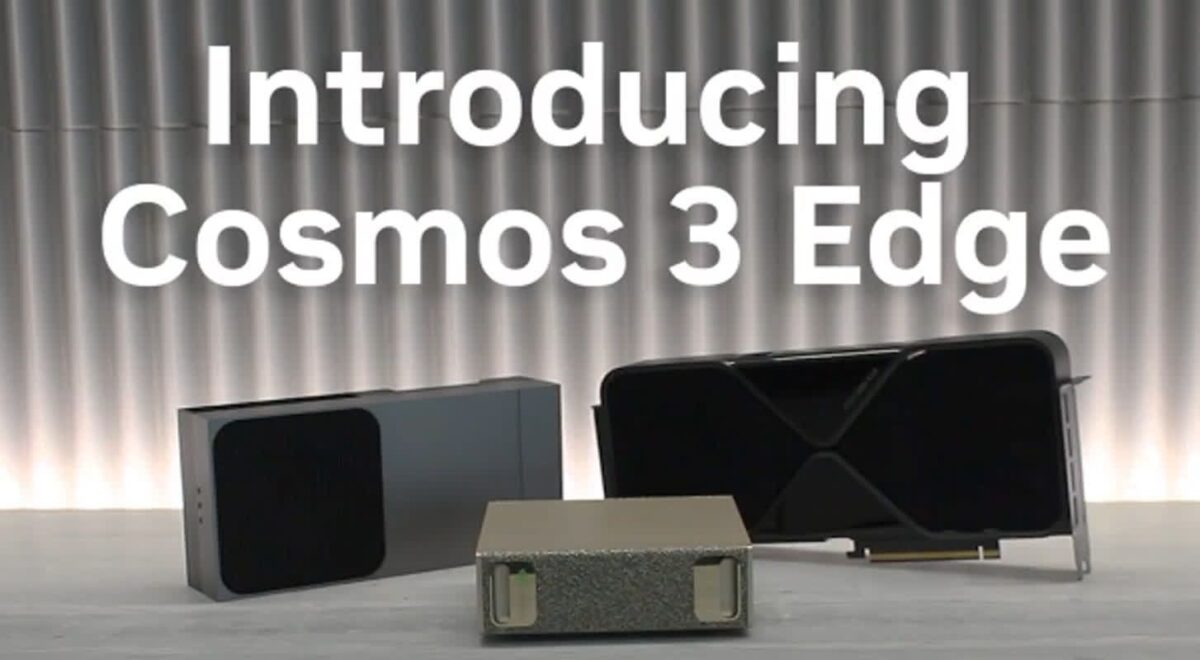
Nvidia has introduced Cosmos 3 Edge, a compact “world model” built to run entirely on a single graphics card — including the consumer GeForce RTX cards found in ordinary PCs. The goal is to give robots and self-driving vehicles a way to understand their surroundings and forecast what happens next without sending data to the cloud.
That local-first design is the whole point. Because the model runs on-device, it can process everything on the spot with no internet connection — a critical requirement for robots and autonomous cars, where a dropped signal or even a split-second of lag can be the difference between a safe move and a costly one.
Nvidia describes Cosmos 3 Edge as a model that lets machines perceive the real world and predict future scenarios rather than simply recognize what is in front of them. It accepts text, images, video, and motion trajectories as input, and it can generate text, images, video, and physical actions in return. In practice, a robot can feed the model a standard RGB camera image, let it interpret the scene, and use the result to decide its next move.
Under the hood, the model pairs two approaches: an autoregressive model and a diffusion model. Nvidia says that combination is what allows the system to first read a situation and then project how it is likely to unfold — the “predict the future” step it is pitching as the model’s central advance.
The company also laid out a concrete path to putting it to work. Alongside the base model, Nvidia published Cosmos 3-Edge-Policy-DROID on Hugging Face, a fine-tuned version tuned specifically for planning a robot’s movement. Both are released under the OpenMDW-1.1 license, with the base model serving as a general-purpose world model and the DROID variant handling hands-on robot control.
Nvidia rounded out the release with lighter generative tools. It unveiled four-step distilled versions of Cosmos 3-Super-Text2Image and Cosmos 3-Super-Image2Video, the image and video models it first shipped in June 2026, using a technique called DMD2 distillation to shrink them. Bundling robotics world models and slimmed-down generative models in the same launch is a clear move to widen the Cosmos ecosystem.
The bigger takeaway is where the computing happens. By pushing this kind of AI onto a single consumer graphics card, Nvidia is trying to cut robots’ and autonomous systems’ dependence on high-powered servers and let them make decisions in real time, out in the field. With the company leaning hard on single-card operation, local processing, and GeForce RTX support, the open question is how fast the Cosmos line actually shows up in real robot control and edge AI deployments.