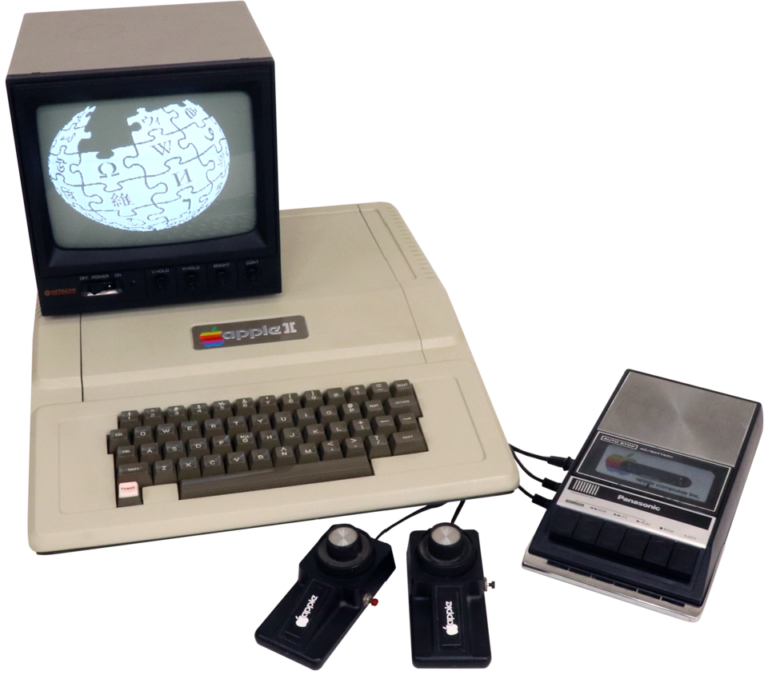
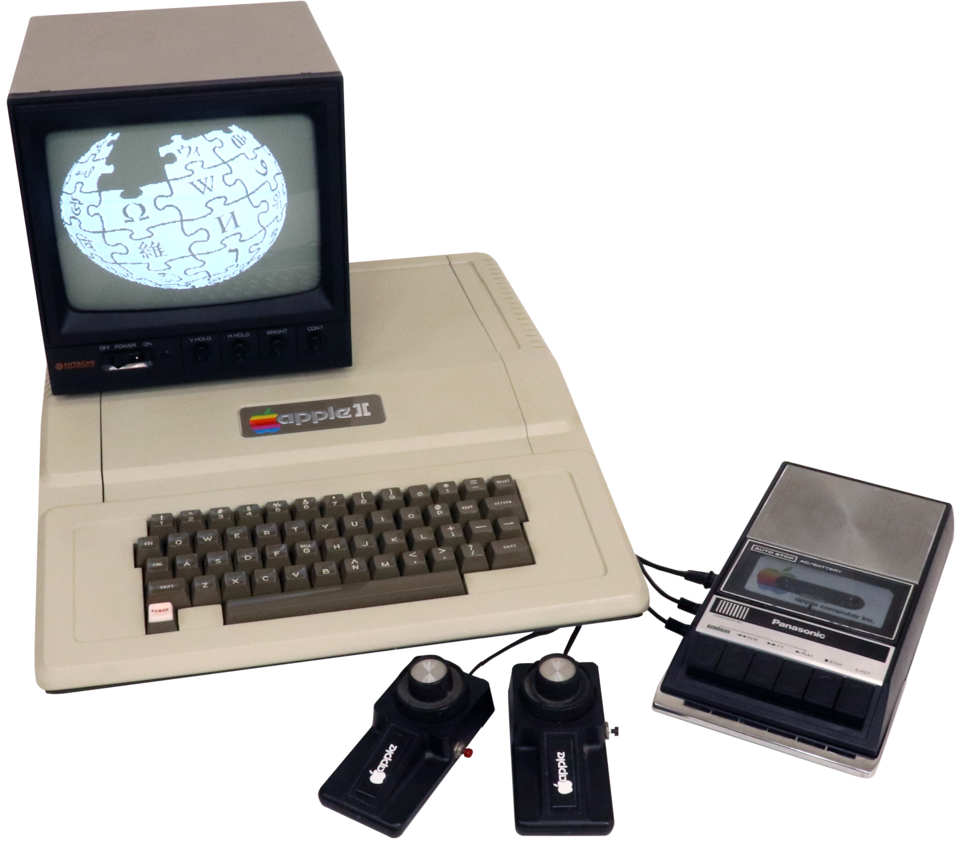
Apple marked its 50th anniversary on April 1, 2026, but the machine that established its place in personal computing arrived a year after the company’s founding. At the first ‘West Coast Computer Faire’ in San Francisco in April 1977, Steve Jobs and Steve Wozniak presented the Apple II to a crowd of more than 12,000 people. The three-day gathering was the world’s largest computer show at the time, bringing personal computing out of workshops and hobby clubs and placing it before the general public.
Before Computers Came Ready to Use
Apple did not create the first microcomputer, a term used for a computer built around a microprocessor rather than the larger processing systems found in mainframes. The MITS Altair 8800 had already captured attention after appearing on the January 1975 cover of ‘Popular Electronics’. It cost roughly $400 with a case, although buyers received a kit that required assembly. The machine shown on the magazine cover was an unfinished shell because MITS had not completed the photographed system before publication.
The Altair 8800 and machines such as the IMSAI 8080 quickly found buyers, but they mainly served experienced hobbyists. Owners entered commands through front-panel switches and read results from rows of lights. Keyboards, monitors and storage devices usually required separate purchases and additional technical work. Still, these machines gave individuals access to processing power that had previously belonged to institutions using shared mainframes.
Wozniak approached the problem differently. The young electrical engineer had worked at Hewlett-Packard and designed electronics for Atari before developing his own computer. He demonstrated the Apple-1 at the Homebrew Computer Club in 1976. The system included an assembled circuit board, though buyers still had to supply a keyboard, display, power supply and enclosure. Byte Shop owner Paul Terrell ordered 50 assembled boards, giving Jobs and Wozniak the commercial opening they needed.
Wozniak designed the electronics with an unusually low chip count, which reduced cost and complexity. Jobs concentrated on how customers would encounter the product. Their next computer arrived inside a molded plastic case with an integrated keyboard and internal power supply. It could display color graphics, generate sound, accept game paddles and run programs written in BASIC. BASIC, short for Beginner’s All-purpose Symbolic Instruction Code, gave new users a relatively accessible way to write their own software.
Three Computers Bring the Industry Home
The Apple II joined the Commodore PET 2001 and Radio Shack TRS-80 in what later became known as the 1977 personal computer trinity. Each arrived as a preassembled desktop system with a QWERTY keyboard and at least 4 KB of RAM, or random-access memory used to hold active programs and data.
Commodore introduced the PET 2001 at the ‘Consumer Electronics Show’ in January 1977. The $795 system used a 1 MHz MOS Technology 6502 processor and placed its computer, keyboard, monochrome monitor and cassette drive inside one enclosure. Radio Shack followed in August with the TRS-80. Priced at $599.95 with its monitor and cassette recorder, the Z80-based system reached customers through RadioShack’s extensive U.S. retail network. The company sold 10,000 units during its first month, far above its original annual projection of 3,000.
The Apple II started at $1,298 with 4 KB of RAM, making it more expensive than its main competitors. It also required buyers to provide a television or monitor and a cassette recorder. Its design offered features that helped justify the price, including color graphics, sound, built-in BASIC stored in ROM and eight internal expansion slots. ROM, or read-only memory, retained essential software even after users switched off the computer. The expansion slots allowed owners to install extra memory, printer connections, communications hardware and improved display equipment.
So, what turned the Apple II from an expensive home computer into a practical platform? Wozniak’s Disk II floppy system provided a major part of the answer. Introduced in 1978, the 5.25-inch drive loaded and saved information much faster than cassette tape. Its controller used far fewer chips than competing designs, helping Apple offer the drive and controller for $595 at launch. Software developers could now distribute larger and more useful programs on disks.
‘VisiCalc’, created by Dan Bricklin and Bob Frankston and released in 1979, gave businesses another reason to purchase the Apple II. The electronic spreadsheet allowed users to change figures and see related calculations update automatically. The National Museum of American History credits its popularity with driving substantial Apple II sales, and the program became one of the earliest examples of a killer application, software valuable enough to encourage customers to buy the hardware required to run it.
Sixteen Years of Upgrades, Games and Classrooms
Apple continued refining the platform as Atari, Commodore, Tandy, Texas Instruments and IBM increased the pressure. The 1979 Apple II Plus raised standard memory to 48 KB and added Applesoft BASIC, a Microsoft-derived version of the language that handled floating-point calculations. These calculations supported numbers with decimal values, making the computer more useful for scientific, financial and business programs.
The Apple IIe arrived in 1983 with 64 KB of memory, lowercase text, a full ASCII character set, improved cursor controls and a joystick connector. ASCII provided a standard system for representing letters, numbers and symbols. An optional 80-column display helped the IIe handle business documents, while a redesign reduced the motherboard from about 120 chips to 31. Fewer components lowered heat output and reduced the number of potential hardware failures.
Games also gave the Apple II a long commercial life. Developers including Brøderbund, Infocom, Origin Systems, Sierra On-Line and Sir-Tech produced titles such as ‘Choplifter’, ‘Karateka’, ‘Lode Runner’, ‘Ultima III’, ‘Wizardry’ and ‘Zork’. Educational releases including ‘Where in the World Is Carmen Sandiego?’ and ‘The Oregon Trail’ helped place Apple computers in American classrooms. By the Macintosh’s 1984 introduction, Apple had sold more than 2 million Apple II computers.
Apple extended the family with the compact Apple IIc in 1984 and the 16-bit Apple IIGS in 1986. The IIGS added improved graphics, sound and a graphical user interface, which allowed users to work with windows, icons and menus instead of relying entirely on typed commands. It also retained compatibility with much of the older 8-bit Apple II software library.
Apple continued producing Apple II hardware until 1993, giving the family a 16-year commercial run. Estimates place total sales across the series at roughly 6 million units. The Macintosh eventually became Apple’s main computer platform, followed by the iMac, iPod, iPhone and iPad, but the Apple II established the formula that carried the company forward: capable engineering, approachable packaging, useful software and room for owners to expand the system.
Anyone preserving an Apple II today should begin with the power supply, capacitors and disk-drive mechanism before attempting a startup. Inspect the motherboard for corrosion, replace failing components with period-appropriate parts, and preserve the original hardware whenever possible. Once the machine runs reliably, modern storage adapters and display interfaces can make software easier to access without erasing the experience that made the Apple II important.